Demystifying Docker: A Complete Guide to Containerization
How Docker Simplifies Application Development, Deployment, and Scaling
Welcome to my corner of the cloud, where ideas scale faster than servers and downtime is not an option! Here, I write about everything from spinning up VPCs to tearing down myths about the cloud. Whether you’re an engineer, a curious learner, or someone who just likes seeing words like 'serverless' and 'auto-scaling,' you’re in the right place. Consider this blog your high-availability zone for tips, tutorials, and tech thoughts—delivered with 99.99% uptime .
When it comes to modern software development, Docker has become a buzzword that you’ve probably heard countless times. But what exactly is Docker, and why has it become such a critical tool for developers, DevOps engineers, and organisations worldwide? Let’s break it down in simple terms.
🔹 What is Docker?
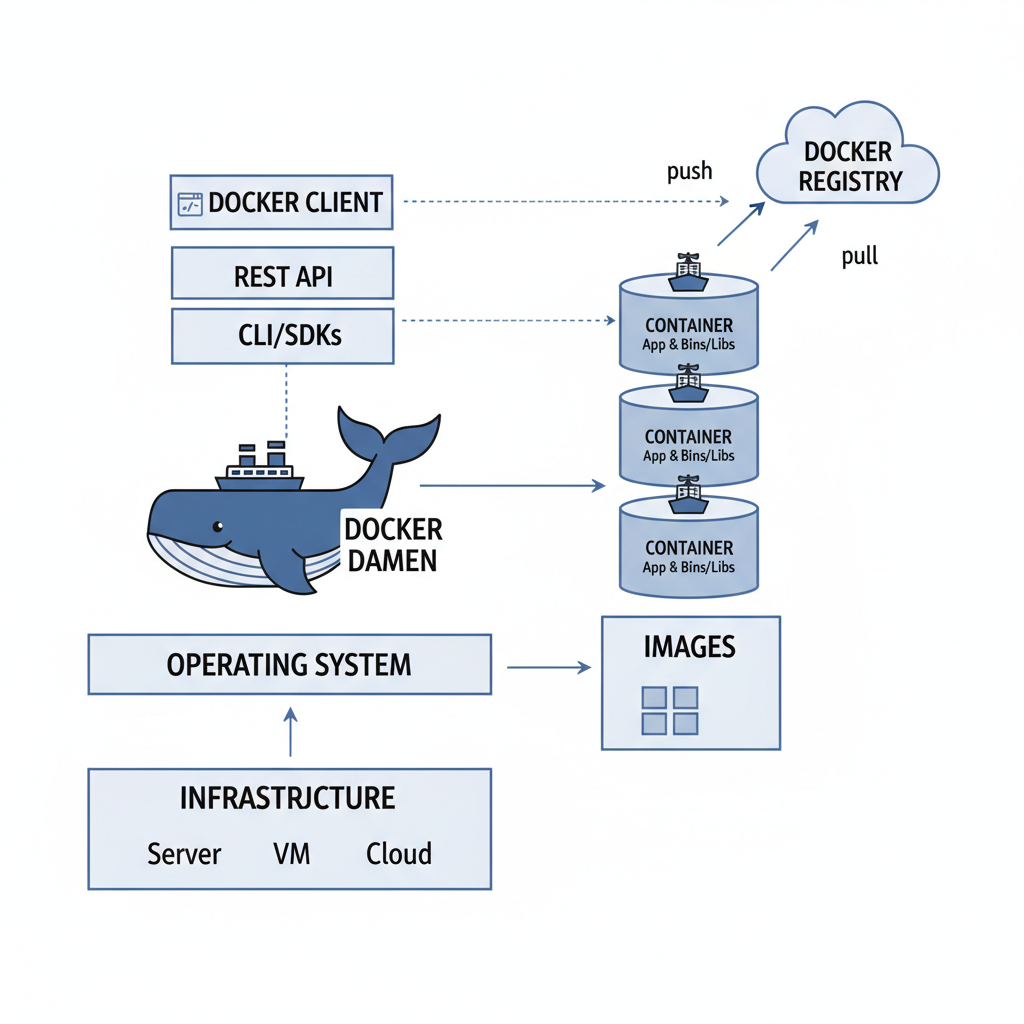
Docker is an open-source platform designed to make it easier to build, ship, and run applications inside containers. Containers are lightweight, portable, and self-sufficient units that package an application along with its dependencies.
Unlike traditional virtual machines, containers don’t require a full operating system. They share the host OS kernel, making them faster, more efficient, and easier to scale.
🔹 Why Use Docker?
Here are some of the key benefits that make Docker so powerful:
Consistency Across Environments
– "It works on my machine" is no longer a problem. With Docker, you can ensure the same environment in development, testing, and production.Lightweight & Fast
– Containers are smaller than virtual machines, which means quicker startup times and lower resource usage.Scalability
– Docker integrates well with orchestrators like Kubernetes and Docker Swarm, allowing applications to scale horizontally.Portability
– A Docker container can run on any machine that has Docker installed—whether it’s your laptop, a server, or the cloud.
🔹 Popular Use Cases of Docker
Microservices Architecture
– Break monolithic applications into smaller, independent services. Each service can be containerised, deployed, and scaled individually.Simplified Development & Testing
– Developers can spin up environments quickly, replicate production locally, and test applications with different dependencies without conflicts.Continuous Deployment Pipelines
– Docker integrates seamlessly with automation tools like Jenkins, GitHub Actions, and GitLab CI, enabling smooth deployments.Cloud-Native Applications
– Cloud providers (AWS, Azure, GCP) all support Docker-based workloads, making applications cloud-ready by design.Legacy App Modernisation
– Even older apps can be containerised, giving them a new life with easier deployment and management.
🔹 Final Thoughts
Docker has completely changed how we think about building, deploying, and running applications. It removes the pain of environment inconsistencies, speeds up development, and empowers businesses to scale efficiently.
Whether you are a beginner learning cloud computing, a DevOps engineer setting up pipelines, or a company adopting microservices, Docker is a must-have in your toolbox.


